


What is Varistor
A varistor (a.k.a. voltage-dependent resistor (VDR)) is a surge protecting electronic component with an electrical resistance that varies with the applied voltage. It has a nonlinear, non-ohmic current–voltage characteristic that is similar to that of a diode. Unlike a diode however, it has the same characteristic for both directions of traversing current. Traditionally, varistors were indeed constructed by connecting two rectifiers, such as the copper-oxide or germanium-oxide rectifier in antiparallel configuration. At low voltage the varistor has a high electrical resistance which decreases as the voltage is raised. Modern varistors are primarily based on sintered ceramic metal-oxide materials which exhibit directional behavior only on a microscopic scale. This type is commonly known as the metal-oxide varistor (MOV).
Advantages of Varistor
The varistor has a stable voltage under over-temperature conditions
In the case of a higher breakdown voltage, the control voltage of the varistor remains almost constant when it exceeds the operating temperature range. When the leakage current increases with the temperature of the component body, the control voltage of the varistor does not change.
The varistor is made of millions of P-N structures
This structure has better volume absorption function and surge voltage withstand function.
The varistor response is very fast.
The varistor has similar behavior characteristics as other semiconductor components. Because the transmission of the varistor is fast, the delay is only within the limit of nanoseconds, so it can meet various practical requirements.
The varistor has a high capacitance value
In the DC circuit, the capacitance of the varistor can not only play the role of decoupling, but also achieve multiple functions of suppressing transient overvoltage.


Why Choose Us
Our Certifications
We are the first in the world to obtain 130℃certification. In our UL1449 certification, the standard requires that the number of lightning surge 15 times to determine the qualified, and our products after 20 lightning surge impact.
Our Team
Our R & D team has been engaged in this industry for 30 years, developed numerous product formulations, is China's first batch of electronic components engineers, electronic components for China has made outstanding contributions to the cause.
Our Factory
Since 2006, Pro-APEX Electronics Co.Ltd has been in the field of electronic components for 17 years. In order to realize social value, we optimized our overseas trade business into a self-sustaining business unit and an independent accounting company according to the requirements of the top management planning masters.
One-Stop Service
In the fields of motor drive and control, power electronics reliability and power supply design, hardware development technology and components application, electromagnetic compatibility technology application, new energy low-voltage electrical apparatus, etc. , all of them have reasonable supporting schemes and technical support for electronic components.
Varistor Materials
Carbon film varistor
Carbon film varistor have largely been replaced by metal types for general purpose applications, due to their poorer tolerance and noise characteristics. However, they are still used in some specialist applications.
The resistor is constructed by forming a carbon film onto a ceramic substrate. This has multiple advantages. Firstly, the film is largely non-inductive, secondly, the ceramic is an excellent insulator for heat and electricity, and thirdly, the layout has a large cross-section. So, their low inductance makes them useful for high-frequency applications and their larger cross-section lends itself to higher operating voltages and better survivability to transients than many other types. As a result, although less widely used, they are still commonly available.
Metal film varistor
Metal film varistor are made by placing a layer of metals such as ruthenium onto an insulating substrate. They are available in a large number of types and packages and compared to carbon film varistor, their construction is simpler to mass-produce and smaller physically.
Metal film varistor have largely replaced carbon film varistor in most standard applications due to their lower noise, tighter tolerances and generally better temperature coefficients. Although often perceived as a ‘standard' resistor, they have evolved from a lower performance base to the point where they are offered with quite high precision (0.1%) and low TCRs in the single-digit PPM/C range. It's worth noting that metal film varistor are offered in both trough hole and surface mount (chip resistor) types.
Wirewound varistor
Wirewound varistor have some characteristics that are attractive in specialist applications, such as high precision instrumentation where tolerances much better than 0.01% and very low-temperature coefficients (TCR) are required.
They are also often the resistor type of choice for high power applications (examples rated up to 100s of watts are available). However, it's worth noting that as they consist of wire wound around an insulated core, which is an inductor by definition, these varistor are not recommended for high-frequency applications, and are generally not available in surface mount form.
Metal oxide varistor
These items are similar to metal film varistor, save that the resistive element is an oxide (often tin). Their performance is subtly different from metal film in that they typically are better for higher voltage and higher power applications than metal film parts.
However, they are typically offered in smaller ranges and may offer reduced tolerances and TCRs. Again, they are offered in both surface mount and through-hole types.
Metal strip varistor
These are specialist varistor generally used for current measuring applications in power supplies. They are characterised by often very low ohmic values, so they are offered with relatively low-temperature coefficients and medium power dissipation to minimally affect the overall circuit operation.
Main Applications of Varistors
Lightning protection
Lightning strikes can cause atmospheric overvoltages, which mostly belongs to inductive overvoltage. The overvoltage generated by the lightning strike on the transmission line is called the direct lightning overvoltage, and its voltage value is particularly high, which can cause great harm with voltage of 102~104V. Therefore, for outdoor power systems and electrical equipment, measures must be taken to prevent overvoltage. The use of ZnO varistor arresters is very effective in eliminating atmospheric overvoltages. Generally, it is connected in parallel with electrical equipment. If the electrical equipment requires a low residual voltage, multilevel protection can be used.
Switch protection
When a circuit with an inductive load is suddenly disconnected, its overvoltage can exceed several times of the power supply voltage. Overvoltage can cause arcing and spark discharge between contacts, which can damage contacts such as contactors, relays and electromagnetic clutches, and shorten the service life of the device. The varistor has a shunt at high voltages, so it can be used to protect the contacts by preventing spark discharges at the moment of contact break. When the varistor is connected in parallel with the inductor, the dry voltage of the switch and the dry voltage of the varistor are the sum of the residual voltage of the varistor. The energy absorbed by the varistor is the energy stored by the inductor. When the varistor is connected in parallel with the switch, the overvoltage on the switch is equal to the residual voltage of the varistor, and the energy absorbed by the varistor is slightly larger than the energy stored in the inductor.
Device protection
In order to prevent the semiconductor devices from being burnt due to overvoltage generated for some reasons, varistors are often used to protect them. The damage of the overvoltage to the transistor can be effectively suppressed between the collector and the emitter of the transistor or the primary shunt varistor of the transformer. Under normal voltage, the varistor is in a high impedance state with minimal leakage current. When subjected to an overvoltage, the varistor quickly changes to a low impedance state, and the overvoltage energy is absorbed by the varistor in the form of a discharge current. After the surge voltage is passed, when the circuit or component is subjected to a normal voltage, the varistor returns to a high impedance state.
What Are the Principles of Varistor Selection
The selection of the voltage V1mA pressure-sensitive
According to the power supply voltage selection, the power supply voltage continuously applied to both ends of the varistor, can not exceed the "maximum continuous working voltage" value listed in the specification. That is, the maximum DC working voltage of the varistor must be greater than the DC working voltage of the power line (signal line) VIN, i.e. VDC ≥ VIN; for 220V AC power supply pressure-sensitive selection, to take full account of the fluctuation of the grid working voltage, the selection of varistor pressure-sensitive voltage value, to leave enough margin. The general fluctuation range of the domestic power grid is 25%. A varistor with a voltage of 470V to 620V should be selected as a more suitable voltage-sensitive resistor. Choosing a higher voltage varistor, which can reduce the failure rate, and extend the service life, but the residual voltage is slightly increased.
The selection of flux flow
The nominal discharge current of the varistor should be greater than the required surge current or the maximum surge current that may occur in the work of the equipment. The nominal discharge current should be calculated according to the number of surge life quotas of the pressure-sensitive resistor curve in the impact of more than 10 times the value, about 30% of the maximum impact flux (i.e. 0.3IP) or so.
The clamping voltage selection
The clamping voltage of the varistor must be less than the maximum voltage that the protected part or equipment can withstand (i.e. safety voltage).
The selection of capacitance Cp
For high-frequency transmission signals, the capacitance Cp should be smaller, and vice versa.
ResistanceMatch
Protected components (line) internal resistance R (R ≥ 2Ω) and varistor transient internal resistance Rv relationship: R ≥ 5Rv; for the protection of components with small internal resistance, without affecting the signal transmission rate, try to use a large capacitance varistor.

A varistor is a voltage-limiting protection device. By using the non-linear characteristics of a varistor, when an overvoltage occurs across a non-linear varistor, the varistor can clamp the voltage to a relatively fixed value, thus protecting the back-end circuit.
The process is understood: when the voltage across the varistor is below its threshold voltage, the current flowing through it is extremely small and it is equivalent to a resistor with infinite resistance. This means that when the voltage applied to it is below its threshold value, it is equivalent to an open switch. When the voltage applied to the varistor is above its threshold voltage, the current flowing through it surges and it is equivalent to a resistor with infinitely small resistance. This means that when the voltage applied to it is above its threshold value, it is equivalent to a closed switch.
Metal Oxide Varistors (MOVs)
Composition: The MOVs consist of a ceramic semiconductor material typically zinc oxide mixed with the small amounts of other metal oxides.
Operation: The MOV's resistance decreases as the voltage across it increases. It clamps the voltage to safe level by conducting excess current.
Applications: The Surge protection in power lines, surge arresters in electrical distribution systems and transient voltage suppression in the electronic circuits.
Silicon Carbide Varistors (SiC)
Composition: The SiC varistors use silicon carbide as the semiconductor material.
Operation: To Similar to MOVs, SiC varistors exhibit a nonlinear voltage-current characteristic conducting when voltage surges exceed a certain threshold.
Applications: The Surge suppression in high-voltage systems such as power transmission lines and substations.
How Varistors Protect Circuits from High Transient Voltages on a Microstructure Level
Transient voltages are temporary voltage spikes that could occur as a result of power source fluctuations, lightning strikes, inductive load switching, electrostatic discharge, etc. The effects of these transients could range from minor to catastrophic, hence the need to protect against their occurrence.
The crystalline structure of MOVs consists of randomly oriented metal oxide grains, which are conductors separated by a resistive intergranular boundary. These boundaries exhibit P-N junction semiconductor characteristics.
In a circuit operating normally and experiencing a low voltage, only a small amount of current flows in the varistor caused by reverse leakage through the junctions. When a high transient voltage that exceeds the varistor's breakdown voltage is applied, avalanche breakdown occurs at the junctions and the varistor becomes a conductor (The device clamps the voltage to a safe level as it conducts).
It's important to note that these devices cannot offer protection against a continuous voltage surge, even if the magnitude of the voltage is significantly lower than the transient voltages it's designed for.
Varistor vs TVS Diode
The ability to protect sensitive circuit parts from high transient voltages is the same function a TVS diode provides. There are notable differences comparing a varistor vs TVS diode which we will be examining.
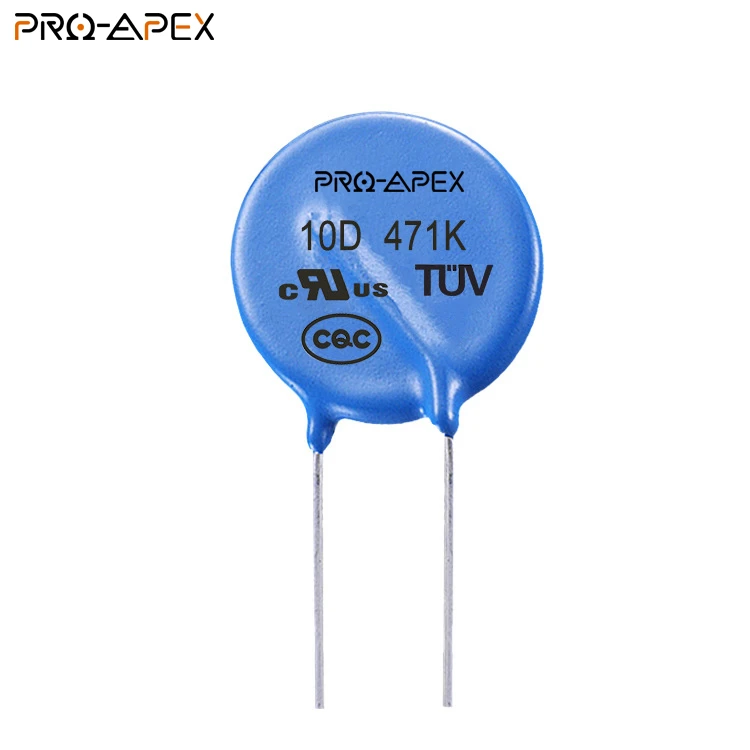
Varistors are bidirectional components suitable for both AC and DC circuits. They come in different design packages. The most popular design, the radial disc, closely resembles a capacitor but should not be confused with one.
These devices can be made from different types of materials. Their composition determines their electrical properties. Studying and comparing the characteristics of various formulations makes for interesting experiments and research. Commercial manufacturing companies even have created proprietary mixtures.
The current-voltage relationship of a varistor can be expressed using the following relationship:
I=KV
Where K and are constants. K is a function of the varistor’s geometry and defines the degree of nonlinearity in resistance experienced by the device. A high value of generally implies a better clamp. For an ideal resistor with a linear V-I relationship, is 1.
The most common type of varistor on the market today is the Metal Oxide Varistor, MOV.
However, before MOVs were introduced, Silicon Carbide, SiC, was the varistor of choice. SiC varistors are manufactured by fusing grains of SiC together to form a ceramic base and combining additives such as graphite, various salts, and oxides to improve the properties of the final material. The drawback of these particular devices, and why MOVs have largely replaced them, is the significant amount of electric current they draw while on standby. SiC varistors have typical draw in the range 3-7.
On the other hand, MOVs have higher values compared to SiC varistors, between 20-50. During the manufacturing process, metal oxides, namely, Zinc Oxide (ZnO) are fused into a ceramic base and combined with additives such as oxides of bismuth, manganese or cobalt. A typical distribution is 90% ZnO and 10% additives. The resulting material has a polycrystalline microstructure that can dissipate large amounts of energy across its entire bulk. Next, the material is sandwiched between metal electrodes.
FAQ
We're well-known as one of the leading varistor manufacturers in China. If you're going to buy bulk high quality varistor at low price, welcome to get free sample from our factory. Also, customized service is available.
load resistor, snubber resistor, audio equipment resistor