


What is Encapsulated Film Capacitor
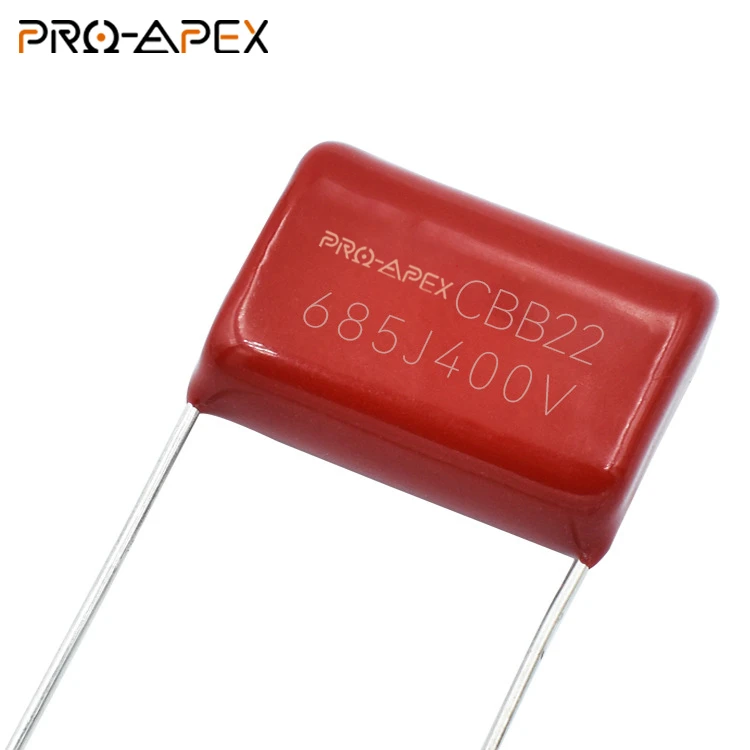
Encapsulated film capacitor is a capacitor that uses polymer film as the dielectric. It is one recent example of a component that uses metalized film with the internal electrodes deposited to the film. Film capacitors can be classified by their structures and the types of dielectrics they contain. The main types of film capacitor structures are winded and layered. Winded film capacitors contain a polymer film that is wound and pressed, and inserted into a case. Layered film capacitors contain multiple layers of polymer film inserted into a case. Winded film capacitors are most commonly used now, as they have a simple structure.
Advantages of Encapsulated Film Capacitor
Self-healing properties
Film capacitors, being metalized, possess self-healing capabilities. In the event of minor damage, they can automatically repair themselves.
High voltage tolerance
During operation, these devices can withstand high voltages without encountering issues or failures.
Non-polarity
In contrast to electrolytic capacitors, film capacitors are non-polar, and they have very low Equivalent Series Resistance (ESR).
Excellent frequency characteristics
When in use, film capacitors demonstrate favorable frequency characteristics.


Why Choose Us
Our Certifications
We are the first in the world to obtain 130℃certification. In our UL1449 certification, the standard requires that the number of lightning surge 15 times to determine the qualified, and our products after 20 lightning surge impact.
Our Team
Our R & D team has been engaged in this industry for 30 years, developed numerous product formulations, is China's first batch of electronic components engineers, electronic components for China has made outstanding contributions to the cause.
Our Factory
Since 2006, Pro-APEX Electronics Co.Ltd has been in the field of electronic components for 17 years. In order to realize social value, we optimized our overseas trade business into a self-sustaining business unit and an independent accounting company according to the requirements of the top management planning masters.
One-Stop Service
In the fields of motor drive and control, power electronics reliability and power supply design, hardware development technology and components application, electromagnetic compatibility technology application, new energy low-voltage electrical apparatus, etc. , all of them have reasonable supporting schemes and technical support for electronic components.
Power film capacitors are used in power electronics devices, phase shifters, X-ray flashes and pulsed lasers, while the low power variants are used as decoupling capacitors, filters and in A/D convertors. Other notable applications are safety capacitors, electromagnetic interference suppression, fluorescent light ballasts and snubber capacitors.
Lighting ballasts are used for proper starting and operation of fluorescent lights. When a ballast is faulty, the light will flicker or fail to start properly. Older ballasts used only an inductor, a solution which provides a poor power factor. New designs use a switched power supply which relies on film capacitors for power factor correction.
Snubber capacitors are protective devices which damp or “snub inductive kickback voltage spikes. These circuits often use film capacitors because of their low self-inductance, high peak current and low ESR, which are all critical factors in a snubber design. Polypropylene film capacitors are most often used in this type of circuit. Snubbers are used in many areas of electronics, especially power electronics in devices such as flyback DC-DC converters and others.
Film capacitors can also be used in a more conventional way as voltage smoothing capacitors, in filters, audio crossovers. They can be used to store energy and release it in a high-current pulse when needed. High-current electrical pulses are used to power pulsed lasers or generate lighting discharges.
The first difference between these three capacitors that is quite obvious is the type of dielectric used and their construction. While film capacitors use thin sheets of plastic film, ceramic capacitors, like the dielectric, use sheets made of ceramic material. In nature, both of them are bipolar. On the other hand, electrolytic capacitors have oxides that act as dielectrics and are polar.
The differences in their production and dielectrics have an enormous impact on their results. As discussed above, a wide variety of capacitance values are available for plastic film/metalized film capacitors. Ceramic capacitors, on the other hand, are only ideal for circuits that have low requirements for capacitance. For specific applications such as analog signal processing and audio circuits, due to the low distortion factor they offer, film capacitors are preferred over ceramic capacitors. Ceramic capacitors also tend to have high nonlinearities at high capacitances that affect the performance of the circuits.
Capacitors with high capacitance and a low cost are favored for applications such as coupling/decoupling circuits. Both electrolytic and film capacitors are also good choices to choose from. The ESR (Equivalent Series Resistance) and ESL (Equivalent Series Inductance) value of the capacitor is another major factor that is considered when designing such circuits. As already discussed, in contrast to electrolytic capacitors, film capacitors have a stronger ESR and ESL performance and a much lower distortion factor and are thus favored over aluminum electrolytic capacitors.
If the aging time between these three capacitors is compared, film capacitors appear to avoid the wearing out process between them for the longest time. For high voltage and high-frequency applications, this makes them a safer option.
One common type of film capacitor is the polyester film capacitor, also known as the Mylar capacitor. Since polyester film provides the best insulation and durability, it is employed in its construction as the dielectric material. Polyester film capacitors are tiny, cheap, and have low dielectric losses. They are frequently used in general-purpose applications such timing circuits, consumer electronics, and audio equipment.
Another kind is the polypropylene film capacitor. Polypropylene is a perfect dielectric material due to its high temperature stability and minimal dielectric losses. Polypropylene film capacitors have strong insulating resistance and low dissipation factor, which make them become the superb choice for applications requiring high precision and stability such as in communications equipment, high-speed digital circuits, and filtering applications.
They are often used in applications involving motors, power supplies, and audio amplifiers. Polycarbonate film capacitors are an additional form of capacitor that employ polycarbonate as the dielectric material. They have excellent temperature stability and are very dielectrically robust.

Materials Used in Encapsulated Film Capacitor
Polyester: Polyester is used for non-critical applications and is usually lower in cost. Polyester dielectric is made by melting polyester resin and stretching it into thin, flat sheets. Polyester capacitors are known for its self-healing properties and high dissipation factor. Polyester capacitors have values from .01uF to above 10uF and at temperatures up to 125 ℃.
Polypropylene (PP): Polypropylene capacitors are utilized for high-frequency and high current applications and have a very low dissipation factor over its entire range as well as over a wide frequency range. For AC capacitor applications, polypropylene is the most suitable dielectric since the dielectric constant and the low loss factor are largely independent of the temperature and frequency. They have a low moisture absorption and high insulation resistance and are available in values from 1uF to 100uF and temperatures up to 105 ℃.
Polyphenylene Sulfide (PPS): Polyphenylene Sulfide is known for its low dissipation factor and very good heat resistance, a combination not found in other capacitors. PPS also has a low dielectric absorption as well as very low moisture absorption. Polyphenylene Sulfide capacitors are available to 150℃. PPS has about the lowest temperature drift of film capacitors.PPS capacitors are a good substitute for polycarbonate film capacitors. The main drawback of this dielectric would be that only one source is able to manufacture this grade of film. (Toray in Japan)
Polycarbonate (PC): Polycarbonate film capacitors offer very low temperature dependency with a wide operating temperature range. They are known for reliability and stability over different environmental conditions, and low losses. They have a heat resistance to 125℃. There is only one supplier who says they manufacture the polycarbonate currently after Bayer decided to discontinue. There are a few suppliers who still have polycarbonate dielectric available and will continue until their supply runs out.
Paper (P): Paper or ‘Kraft Paper’ is the oldest of the film capacitor dielectrics. The paper must be impregnated with epoxy, wax, oil, or another suitable impregnate. It is still popular for high voltage and AC rated capacitors operating at lower frequencies. Paper can also be wound with plastic dielectrics in combination dielectric capacitors.
Polyethylene Naphthalate (PEN): Another form of polyester, it has very good heat resistance. PEN has a high dielectric constant with a high dielectric strength that provides good volumetric efficiency for metalized construction. It is a great general purpose capacitor. PEN is available to 125 ℃ and is utilized in many film SMD capacitors.
Teflon (PTFE): PTFE probably has the lowest leakage and lowest dielectric absorption. It has a very low dissipation factor along with a wide range of temperature (can get to 250℃ for some), low temperature drift and very good stability. PTFE is a good film capacitor for critical analog applications although more costly.
The Production Process of Encapsulated Film Capacitor
Film stretching and metallization—To increase the capacitance value of the capacitor, the plastic film is drawn using a special extrusion process of bi-axial stretching in longitudinal and transverse directions, as thin as is technically possible and as allowed by the desired breakdown voltage. The thickness of these films can be as little as 0.6 μm. In a suitable evaporation system and under high vacuum conditions (about 1015 to 1019 molecules of air per cubic meter) the plastic film is metallized with aluminum or zinc. It is then wound onto a so-called “mother roll” with a width of about 1 meter.
Film slitting—Next, the mother rolls are slit into small strips of plastic film in the required width according to the size of the capacitors being manufactured.
Winding—Two films are rolled together into a cylindrical winding. The two metallized films that make up a capacitor are wound slightly offset from each other, so that by the arrangement of the electrodes one edge of the metallization on each end of the winding extends out laterally.
Flattening—The winding is usually flattened into an oval shape by applying mechanical pressure. Because the cost of a printed circuit board is calculated per square millimeter, a smaller capacitor footprint reduces the overall cost of the circuit.
Application of metallic contact layer—The projecting end electrodes are covered with a liquefied contact metal such as (tin, zinc or aluminum), which is sprayed with compressed air on both lateral ends of the winding.
Healing—The windings which are now electrically connected by the have to be “healed” . This is done by applying a precisely calibrated voltage across the electrodes of the winding so that any existing defects will be “burned away” (see also “self-healing” below).
Impregnation—For increased protection of the capacitor against environmental influences, especially moisture, the winding is impregnated with an insulating fluid, such as silicone oil.
Attachment of terminals—The terminals of the capacitor are soldered or welded on the end metal contact layers of the schoopage.
Coating—After attaching the terminals, the capacitor body is potted into an external casing, or is dipped into a protective coating. For lowest production costs some film capacitors can be used “naked” , without further coating of the winding.
Electrical final test—All capacitors (100%) should be tested for the most important electrical parameters, capacitance (C), dissipation factor (tan δ) and impedance (Z).
How to Prevent Encapsulated Film Capacitor Failures
Properly select capacitors: Choosing the right type and parameters of capacitors for a specific application is crucial. Ensure that the rated voltage, capacitance value, temperature characteristics, and other specifications of the capacitor meet the design requirements. Excessive voltage or current can lead to capacitor damage.
Pay attention to voltage polarity: If capacitors have polarity, they must be connected correctly. Reverse polarity connection can lead to capacitor damage. Make sure that capacitor polarity is correctly identified in circuit design and installation.
Avoid overvoltage: Use overvoltage protection circuits such as TVS diodes or MOV (metal-oxide varistor) to prevent capacitors from experiencing excessive voltage. These protective devices can absorb voltage spikes and protect the capacitors from damage.
Control operating temperature: Ensure that capacitors operate within their rated temperature range. High temperatures can reduce capacitance values and shorten the capacitor’s lifespan. Low temperatures can also affect capacitor performance.
Prevent overcurrent: Use current limiters, fuses, or current-limiting circuits to prevent capacitors from experiencing excessive current. Excessive current can cause capacitors to heat up and become damaged.
Avoid mechanical damage: Capacitors are often fragile and can be easily damaged by mechanical shocks or vibrations. Consider mechanical protection in the design or use protective covers or mounting fixtures near the capacitors.
Quality control: Ensure the use of high-quality capacitors and avoid counterfeit products. Regularly inspect capacitors for cracks, leakage, or other obvious defects.
Maintenance and inspection: Regularly inspect and maintain electronic equipment, especially capacitors in aging or critical applications. Replace aging or problematic capacitors to ensure system reliability.
Avoid open-Circuit or short-circuit conditions: Do not operate capacitors in open-circuit (without a load) or short-circuit (directly connecting the positive and negative terminals), as this can damage the capacitors.
FAQ
We're well-known as one of the leading encapsulated film capacitor manufacturers in China. If you're going to buy bulk high quality encapsulated film capacitor at low price, welcome to get free sample from our factory. Also, customized service is available.
custom resistor, longevity ntc thermistor, snubber resistor