


What is Ceramic Capacitor
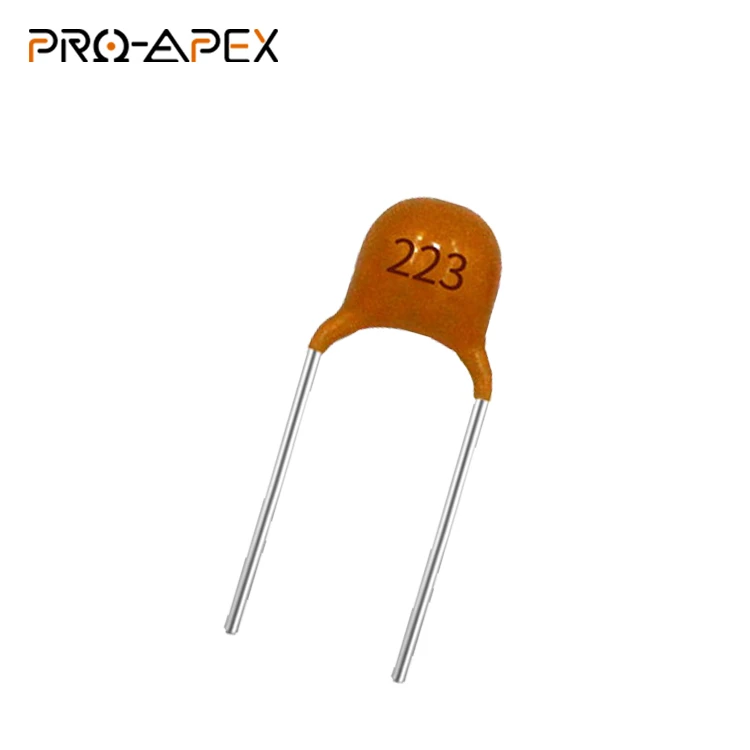
A ceramic capacitor uses a ceramic material as the dielectric. Ceramics were one of the first materials to be used in the producion of capacitors, as it was a known insulator. Ceramic capacitors are usually made with very small capacitance values, typically between 1nF and 1µF, although values up to 100µF are possible. Ceramic capacitors are also very small in size and have a low maximum rated voltage. They are not polarized, which means that they may be safely connected to an AC source. Ceramic capacitors have a great frequency response due to low parasitic effects such as resistance or inductance.
Advantages of Ceramic Capacitor
High capacitance density
One of the primary advantages of ceramic capacitors is their high capacitance density. Ceramic materials have a high dielectric constant, allowing them to store a significant amount of charge in a relatively small volume. This high capacitance density makes ceramic capacitors ideal for applications where space-saving is crucial, such as in portable electronic devices and integrated circuits.
Wide range of capacitance values
Ceramic capacitors are available in a wide range of capacitance values, from picofarads (pF) to microfarads (μF). This versatility allows designers to select capacitors with the appropriate capacitance for their specific application requirements, whether it be for filtering, decoupling, or tuning circuits.
Low equivalent series resistance (ESR)
Ceramic capacitors typically exhibit low equivalent series resistance (ESR), which minimizes energy losses and improves their efficiency in energy storage and signal filtering applications. The low ESR of ceramic capacitors also makes them suitable for high-frequency circuits, where minimal losses are essential for maintaining signal integrity.
High stability and reliability
Ceramic capacitors offer excellent stability and reliability over a wide range of operating conditions. They exhibit minimal drift in capacitance value over time and temperature variations, ensuring consistent performance in diverse environments. Additionally, ceramic capacitors have a long service life and are less prone to aging effects compared to other types of capacitors.


Why Choose Us
Our Certifications
We are the first in the world to obtain 130℃certification. In our UL1449 certification, the standard requires that the number of lightning surge 15 times to determine the qualified, and our products after 20 lightning surge impact.
Our Team
Our R & D team has been engaged in this industry for 30 years, developed numerous product formulations, is China's first batch of electronic components engineers, electronic components for China has made outstanding contributions to the cause.
Our Factory
Since 2006, Pro-APEX Electronics Co.Ltd has been in the field of electronic components for 17 years. In order to realize social value, we optimized our overseas trade business into a self-sustaining business unit and an independent accounting company according to the requirements of the top management planning masters.
One-Stop Service
In the fields of motor drive and control, power electronics reliability and power supply design, hardware development technology and components application, electromagnetic compatibility technology application, new energy low-voltage electrical apparatus, etc. , all of them have reasonable supporting schemes and technical support for electronic components.
Semiconductor ceramic capacitors
Microminiaturization of capacitors, that is, capacitors in the smallest possible volume obtain the largest possible capacity, which is one of the trends in the development of capacitors. For the separation of capacitor components, there are two basic ways of miniaturization, even if the dielectric material dielectric constant is as high as possible and make the thickness of the dielectric layer as thin as possible.
Among ceramic materials, ferroelectric ceramics have a high dielectric constant, but it is difficult to make the ceramic dielectric as thin as possible when making ordinary ferroelectric ceramic capacitors with ferroelectric ceramics. First of all, because of the low strength of ferroelectric ceramics, it is easy to break when thin, which is difficult to carry out the actual production operation, and secondly, when the ceramic dielectric is very thin, it is easy to cause a variety of organizational defects, and the production process is very difficult.
Surface layer ceramic capacitors use a very thin insulating layer formed on the surface of semiconductor ceramics such as BaTiO3 as the dielectric layer, and the semiconductor ceramics itself can be regarded as a series circuit of the dielectric. The thickness of the insulating surface layer of surface layer ceramic capacitors fluctuates between 0.01 and 100 μm depending on the formation method and conditions. This makes use of the very high dielectric constant of ferroelectric ceramics and effectively thins the thickness of the dielectric layer, which is a proven solution for the preparation of micro and small ceramic capacitors.
Grain boundary layer ceramic capacitors
The surface of BaTiO3 semiconductor ceramics with fully developed grains is coated with appropriate metal oxides (e.g. CuO or Cu2O, MnO2, Bi2O3, Tl2O3, etc.) and heat treated under oxidation conditions at the appropriate temperature. A thin solid-solution insulating layer is formed on the grain boundaries. This thin solid-solution insulating layer has high resistivity (up to 1012-1013 Ω-cm), and although the ceramic grain interior is still a semiconductor, the entire ceramic body behaves as an insulator medium with an apparent dielectric constant as high as 2 × 10⁴ to 8 × 10⁴. The capacitor prepared with this porcelain is called a grain boundary layer ceramic capacitor, referred to as a BL capacitor.
High-voltage ceramic capacitor
With the rapid development of the electronics industry, the urgent need to develop high breakdown voltage, low loss, small size, and high reliability of high-voltage ceramic capacitors. The high-voltage ceramic capacitors successfully developed been widely used in electric power systems, laser power supplies, tape recorders, color TV, electronic microscope, copier, office automation equipment, astronautics, missiles, navigation and so on.
Barium titanate-based ceramic materials have the advantages of high dielectric coefficient and good AC voltage withstand characteristics but also have the disadvantages of capacitance change rate with the rise of dielectric temperature and insulation resistance decline. The Curie temperature of strontium titanate crystal is -250℃, and it is a cubic crystal system chalcogenide structure at room temperature, which is paraelectric and does not have a spontaneous polarization phenomenon. The change of dielectric coefficient of strontium titanate-based ceramic material is small under high voltage, and the tgδ and capacitance change rate is small, these advantages make it very favorable as high voltage capacitor dielectric.
Multilayer ceramic capacitors
Multilayer ceramic capacitor (Multilayer Ceramic Capacitor, MLCC) is the most widely used type of chip component, it is the inner electrode material, and ceramic blanks are laminated in parallel with alternate layers and fired into a whole, also known as chip monolithic capacitors, with small size, high specific capacitance, high precision, can be mounted on printed circuit boards (PCB), hybrid integrated circuits ( They can be mounted on printed circuit boards (PCBs) and hybrid integrated circuits (HICs), effectively reducing the size and weight of electronic information terminal products (especially portable products) and improving product reliability. It is in line with the development direction of miniaturization, lightweight, high performance, and multi-function of the IT industry.
Difference Between Ceramic Capacitor and Electrolytic Capacitor
| Basis of Difference | Ceramic Capacitor | Electrolytic Capacitor |
| Definition | A type of capacitor which uses ceramic material as the dielectric medium between its plates is called ceramic capacitor. | A capacitor that uses an electrolyte (solid, liquid or gel) in order to increase its capacitance value is known as electrolytic capacitor. |
| Structure | In a ceramic capacitor, a ceramic material separates its electrode plates. | In an electrolytic capacitor, a layer of metal oxide and an electrolyte separate the electrode plates. |
| Dielectric material | A ceramic capacitor uses a ceramic substance as dielectric medium. | An electrolytic capacitor has a thin layer of metal oxide that acts as the dielectric medium in the capacitor. |
| Circuit symbol |  |
 |
| Equivalent series resistance (ESR) | The equivalent series resistance of a ceramic capacitor is low. | The equivalent series resistance of an electrolytic capacitor is comparatively high. |
| Microphony | Microphony happens in ceramic capacitors. | The electrolytic capacitors do not show microphony. |
| Polarization | The ceramic capacitor is a type of non-polarized capacitor. | The electrolytic capacitor is the type of polarized capacitor. |
| Use in AC circuit | Ceramic capacitor can be used in AC circuits as well as DC circuits. | Electrolytic capacitor cannot be used in AC circuit. It can be used in DC circuits only. |
| Temperature stability | Ceramic capacitors have good temperature stability. | The temperature stability of the electrolytic capacitors is poor. |
| Life span | Ceramic capacitors have longer life span. | The life span of an electrolytic capacitor is comparatively shorter. |
| Capacitance | The capacitance value of ceramic capacitors is relatively low. | Electrolytic capacitors have relatively higher capacitance values. |
| Tolerance | Ceramic capacitors have low tolerance. | The tolerance of the electrolytic capacitors is high. |
| Size | Ceramic capacitors are smaller in size. | The size of electrolytic capacitors is relatively larger. |
| Applications | Ceramic capacitors are widely in high frequency applications, in resonant circuits in transmitter stations, in power circuit breakers, induction furnaces, as MLCC in PCBs, etc. | The common applications of electrolytic capacitors are: to reduce voltage fluctuations, used for noise filtering, for smoothing the rectified AC, in audio frequency amplifiers, etc. |
Manufacturing Process and Quality Control of Ceramic Capacitors


1. Material selection
The choice of materials is fundamental in ceramic capacitor manufacturing. High-quality ceramic powders, typically based on materials like aluminum oxide (alumina) or titanium oxide, are selected for their dielectric properties. The purity and uniformity of these materials directly influence the electrical characteristics and reliability of the capacitors.
2. Forming
The forming process involves shaping the ceramic powder into the desired capacitor structure. This is typically achieved through pressing or extrusion methods. Forming ensures uniformity in shape and size, laying the foundation for consistent electrical performance.
3. Firing
After forming, the green ceramic bodies are fired at high temperatures in a controlled atmosphere kiln. This firing process sinters the ceramic particles, creating a solid and stable structure with the desired electrical properties. Precise temperature and atmosphere control during firing are critical to achieving the required dielectric properties.
4. Electrode deposition
Electrode materials, such as silver or palladium, are deposited onto the fired ceramic bodies to form the capacitor plates. Thin layers of conductive material are applied using techniques like screen printing or sputtering. Uniform electrode deposition ensures consistent capacitance and low equivalent series resistance (ESR).
5. Termination
Termination involves attaching external leads or terminals to the capacitor electrodes. This step facilitates the connection of the capacitor to the circuit. Proper termination techniques, such as soldering or welding, are essential to ensure mechanical stability and reliable electrical connections.
6. Testing and quality control
Throughout the manufacturing process, ceramic capacitors undergo rigorous testing to verify their electrical performance and reliability. Key parameters such as capacitance, voltage rating, insulation resistance, and dissipation factor are tested to meet industry standards and customer specifications. Any capacitors failing to meet these criteria are rejected to maintain product quality.
7. Environmental testing
In addition to electrical testing, ceramic capacitors are subjected to environmental stress testing to evaluate their performance under various conditions. This may include temperature cycling, humidity testing, mechanical shock, and vibration testing. Environmental testing helps assess the capacitors' robustness and suitability for different application environments.
8. Traceability and documentation
Proper documentation of the manufacturing process and test results is essential for quality control and traceability. Each capacitor is typically assigned a unique identifier or batch code, allowing manufacturers to track its production history and verify compliance with specifications.
General Precautions for Ceramic Capacitors
General handling matters needing attention
Multilayer ceramic capacitors are easily broken when thrown. In addition to surface damage, capacitance changes, dissipation factor rises, insulation resistance drops, and dielectric strength drops.
Rolling the bulk multilayer ceramic capacitors together will grind the metal of the terminals to the surface of the other capacitors. Metal traces left on capacitors can lead to failure hazards such as creepage.
Multilayer ceramic capacitors should never be handled by hand, because sweat and skin oil will make the solderability of the terminal electrodes worse, and it is difficult to clean up.
Multilayer ceramic capacitors are never allowed to be handled with metal tools. Metal tweezers will chip off chips or leave metal traces on the surface of the capacitor. Plastic or plastic-encapsulated metal tweezers are recommended when using tweezers. Use to keep the applied pressure to a minimum.
Matters needing attention during transportation
To the extent possible, it should be shipped in its original unopened packaging. If opened, the protective material originally attached should be replaced and resealed.
Do not pack multilayer ceramic capacitors directly with paper or cards, because some papers contain sulfur components, which will adversely affect the solderability of the capacitors. Bulk laminated ceramic electro-pneumatics should be cushioned with foam plastic that does not contain sulfur to avoid damage caused by collision and grinding during transportation.
Storage
If the multilayer ceramic capacitors encounters sulfur dioxide, chlorine, other acidic gases or humid air, the electrode terminals are easily oxidized and affect the solderability.
Paper and rubber contain sulfur substances and cannot be stored together with multilayer ceramic capacitors.
Unused multilayer ceramic capacitors should preferably be kept in their original packaging, and those that have been opened should be resealed as soon as possible. It can also be stored in an airtight container to avoid environmental impact. Therefore, some multilayer ceramic capacitors manufacturers will place multi-disc capacitors in a relatively sealed can.
If it is stored for a long time, it is best to maintain it between -5 and +40℃, and the relative humidity is between 40% and 60%.
Direct sunlight will deteriorate the tape and contaminate the capacitor.
How Does the Use of Ceramic Capacitors Cause Overvoltage
Overvoltage is a common occurrence in power systems and electronic devices, caused by voltage exceeding the normal operating voltage range of the equipment or circuit, leading to device damage and accidents.
Formation of overvoltage
Overvoltage may be caused by various factors. In power systems, it could be due to transient voltage spikes caused by lightning, operational errors, equipment faults, or other abnormal conditions. In electronic devices, overvoltage may occur due to unstable power sources, component aging, or poorly designed circuits.
Harm Caused by Overvoltage in Ceramic Capacitors
Damage to ceramic capacitor capacitance
Overvoltage can damage the insulation material inside ceramic capacitors, leading to failure and a decrease in circuit performance. It may also result in the entire circuit system becoming dysfunctional.
Fire hazards
If overvoltage causes a short circuit in ceramic capacitors, it may lead to a fire. Especially in high-temperature and high-humidity environments, the heat and sparks generated by a short circuit could ignite surrounding flammable materials, causing a fire accident.
Endangering personal safety
Overvoltage may pose a risk of electric shock to individuals. Particularly during maintenance or replacement of circuit components, there is a risk of electric shock to maintenance personnel.
FAQ
We're well-known as one of the leading ceramic capacitor manufacturers in China. If you're going to buy bulk high quality ceramic capacitor at low price, welcome to get free sample from our factory. Also, customized service is available.
resistor manufacturer, passive component resistor, precision ntc thermistor