


What is Safety Ceramic Capacitor
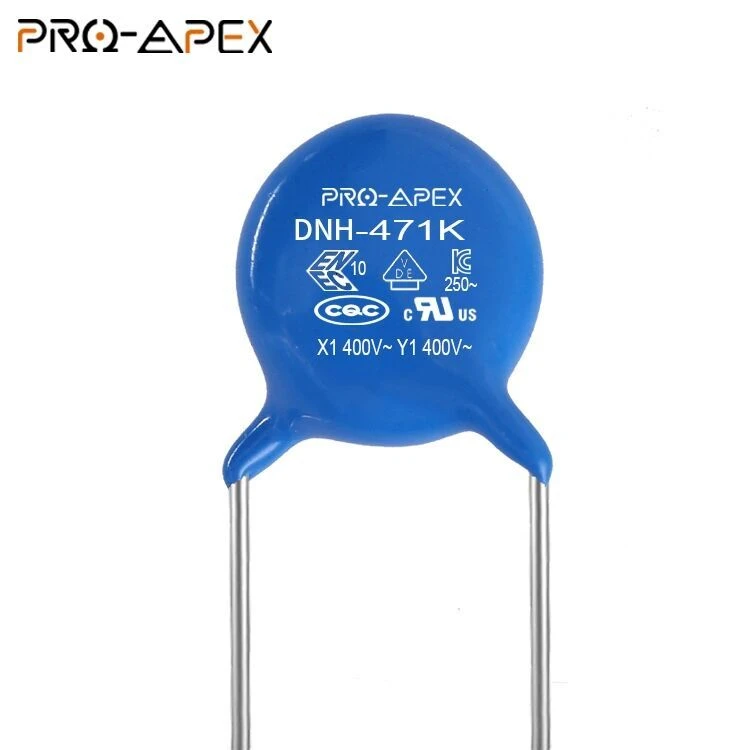
Safety ceramic capacitors are fixed, non-polarized capacitors in which the ceramic materials act as a dielectric. Ceramic capacitors consist of a metal layer and alternating layers with ceramics. During the manufacturing of ceramic capacitors, a metal is coated at either end of a thin ceramic dielectric material. Several of these ceramic layers are stacked together and are separated from each layer using more ceramic. The layers are connected by metal electrodes, which are taken out as terminal leads. Ceramic capacitor values vary from 1pF to about 1µF, with a working ceramic capacitor voltage rating of up to a few thousand volts. These capacitors are suitable for high-temperature applications.
Advantages of Safety Ceramic Capacitor
Accurate tolerances and precision
Ceramic capacitors are mainly used for high stability performances and low-loss devices. These devices provide very accurate results, and also, the capacitance values of these capacitors are stable with respect to the applied voltage, frequency and temperature.
Wide Range of Capacitance Values
Ceramic capacitors are available in a wide range of capacitance values, from picofarads (pF) to microfarads (μF). This versatility allows designers to select capacitors with the appropriate capacitance for their specific application requirements, whether it be for filtering, decoupling, or tuning circuits.
Low Cost
Another advantage of ceramic capacitors is their relatively low cost compared to other types of capacitors, such as tantalum or film capacitors. This cost-effectiveness makes ceramic capacitors a preferred choice for mass-produced electronic devices and applications where budget constraints are a consideration.
High Voltage Ratings
Ceramic capacitors are available with high voltage ratings, allowing them to be used in applications requiring high voltage handling capabilities. These capacitors can withstand voltage levels ranging from a few volts to several kilovolts, making them suitable for a wide range of voltage-sensitive circuits and systems.


Why Choose Us
Our Certifications
We are the first in the world to obtain 130℃certification. In our UL1449 certification, the standard requires that the number of lightning surge 15 times to determine the qualified, and our products after 20 lightning surge impact.
Our Team
Our R & D team has been engaged in this industry for 30 years, developed numerous product formulations, is China's first batch of electronic components engineers, electronic components for China has made outstanding contributions to the cause.
Our Factory
Since 2006, Pro-APEX Electronics Co.Ltd has been in the field of electronic components for 17 years. In order to realize social value, we optimized our overseas trade business into a self-sustaining business unit and an independent accounting company according to the requirements of the top management planning masters.
One-Stop Service
In the fields of motor drive and control, power electronics reliability and power supply design, hardware development technology and components application, electromagnetic compatibility technology application, new energy low-voltage electrical apparatus, etc. , all of them have reasonable supporting schemes and technical support for electronic components.
What Are the Differences Between Safety Ceramic and Electrolytic Capacitors
Construction: Ceramic capacitors are made from layers of ceramic material that have been fired at high temperatures and then coated with metallic electrodes. They are small, lightweight, and have a very low loss tangent, which makes them ideal for high-frequency applications. Electrolytic capacitors, on the other hand, are made by rolling layers of aluminum foil and a thin strip of paper or polymer together and then soaking them in an electrolyte solution. They are larger and heavier than ceramic capacitors and have a higher loss tangent, which makes them less suitable for high-frequency applications.
Capacitance: Ceramic capacitors generally have lower capacitance values than electrolytic capacitors. The capacitance of a capacitor is a measure of its ability to store electrical charge and is typically measured in microfarads (µF). Ceramic capacitors typically have values in the range of 1 pF to 100 nF, while electrolytic capacitors can have values up to several thousand µF.
Voltage rating: Electrolytic capacitors have a much higher voltage rating than ceramic capacitors. The voltage rating of a capacitor is the maximum voltage that can be applied across it without damaging it. Ceramic capacitors typically have voltage ratings in the range of 25 V to 50 V, while electrolytic capacitors can have ratings up to several hundred volts.
Polarization: Electrolytic capacitors are polarized, which means that they have a positive and a negative terminal. The polarity of an electrolytic capacitor must be observed when it is connected in a circuit, as reversing the polarity can damage the capacitor. Ceramic capacitors are not polarized and can be connected in either direction.
Cost: Ceramic capacitors are generally less expensive than electrolytic capacitors.
Ceramic capacitors are small, high-frequency components with low capacitance values and low voltage ratings, while electrolytic capacitors are larger, low-frequency components with high capacitance values and high voltage ratings. They are used in different types of circuits and applications, and selecting the right type of capacitor depends on the specific requirements of the circuit.
Mixing: Ceramic powder is mixed with binder and solvents to create the slurry, this makes it easy to process the material.
Tape Casting: The slurry is poured onto conveyor belt inside a drying oven, resulting in the dry ceramic tape. This is then cut into square pieces called sheets. The thickness of the sheet determines the voltage rating of the capacitor.
Screen Printing and Stacking: The electrode ink is made from a metal powder that is mixed with solvents and ceramic material to make the electrode ink. The electrodes are now printed onto the ceramic sheets using a screen printing process. This is similar to a tshirt printing process. After that the sheets are stacked to create a multilayer structure.
Lamination: Pressure is applied to the stack to fuse all the separate layers, this created a monolithic structure. This is called a bar.
Cutting: The bar is cut into all the separate capacitors. The parts are now in what is called a 'green' state. The smaller the size, the more parts there are in a bar.
Firing: The parts are fired in kilns with slow moving conveyor belts. The temperature profile is very important to the characteristics of the capacitors.
Termination: The termination provides the first layer of electrical and mechanical connection to the capacitor. Metal powder is mixed with solvents and glass frit to create the termination ink. Each terminal of the capacitor is then dipped in the ink and the parts are fired in kilns.
Plating: Using an electroplating process, the termination is plated with a layer of nickel and then a layer of tin. The nickel is a barrier layer between the termination and the tin plating. The tin is used to prevent the nickel from oxidizing.
Testing: The parts are tested and sorted to their correct capacitance tolerances.
Causes and Solutions for Fail of Safety Ceramic Capacitors
The first possibility is thermal decomposition. When capacitors are subjected to instantaneous or prolonged high-frequency and high-current working conditions, the ceramic capacitors may generate heat. Although the heat generation rate is slow, the temperature rises rapidly, leading to thermal decomposition at high temperatures.
The second possibility is chemical degradation. There are gaps between the internal molecules of the ceramic capacitors, and defects such as cracks and voids may occur during the capacitor manufacturing process (potential hazards in the production of inferior products). In the long run, some chemical reactions can produce gases such as ozone and carbon dioxide. When these gases accumulate, they can affect the outer encapsulation layer and create gaps, resulting in crack.
The third possibility is ion breakdown. High voltage ceramic capacitors rely on ions actively moving under the influence of an electric field. When ions are subjected to a prolonged electric field, their mobility increases. In the case of excessive current, the insulation layer can be damaged, leading to breakdown.
To extend the lifespan of capacitors, the following suggestions can be considered:
1)Replace the dielectric material of the capacitors. For example, circuits originally using X5R, Y5T, Y5P, and other Class II ceramics can be replaced with Class I ceramics like N4700. However, N4700 has a smaller dielectric constant, so capacitors made with N4700 will have larger dimensions for the same voltage and capacitance. Class I ceramics generally have insulation resistance values more than ten times higher than Class II ceramics, providing much stronger insulation capability.
2)Choose capacitor manufacturers with better internal welding processes. This involves the flatness and flawlessness of ceramic plates, the thickness of silver plating, the fullness of ceramic plate edges, the quality of soldering for leads or metal terminals, and the level of epoxy coating encapsulation. These details are related to the internal structure and appearance quality of the capacitors. Capacitors with better appearance quality usually have better internal manufacturing.
Use two capacitors in parallel instead of a single capacitor. This allows the voltage originally borne by a single capacitor to be distributed among two capacitors, improving the overall durability of the capacitors. However, this method increases costs and requires more space for installing two capacitors.
3)For extremely high voltage capacitors, such as 50kV, 60kV, or even 100kV, the traditional single ceramic plate integrated structure can be replaced with a double-layer ceramic plate series or parallel structure. This utilizes double-layer ceramic capacitors to enhance the voltage withstand capability. This provides a sufficiently high voltage margin, and the larger the voltage margin, the longer the predictable lifespan of the capacitors.
Application of Safety Ceramic Capacitor
Consumer Electronics
Ceramic capacitors find extensive use in consumer electronics, including smartphones, tablets, laptops, and televisions. They are employed in power supplies for voltage regulation, noise filtering, and decoupling applications, ensuring stable and efficient operation of these devices.
Automotive Electronics
In the automotive industry, ceramic capacitors are indispensable components used in engine control units (ECUs), airbag systems, infotainment systems, and safety features like anti-lock braking systems (ABS). Their compact size, high capacitance density, and temperature stability make them ideal for harsh automotive environments.
Medical Devices
Medical devices, such as patient monitors, defibrillators, and diagnostic equipment, rely on ceramic capacitors for their compact size, high reliability, and precision performance. Ceramic capacitors are used in power supplies, signal conditioning circuits, and filtering applications to ensure the accuracy and safety of medical diagnostics and treatments.
Industrial Equipment
Ceramic capacitors are integral to the operation of various industrial equipment, including motor drives, robotics, and automation systems. They provide energy storage, filtering, and noise suppression in power electronics, contributing to the efficiency and reliability of industrial processes.
Aerospace and Defense
In aerospace and defense applications, where reliability and performance are paramount, ceramic capacitors are widely employed in avionics, radar systems, communications equipment, and missile guidance systems. Their ability to withstand high temperatures, shock, and vibration makes them suitable for use in demanding aerospace and defense environments.
Renewable Energy Systems
Ceramic capacitors play a vital role in renewable energy systems, such as solar inverters, wind turbines, and energy storage systems. They are utilized for DC-link capacitors, voltage regulation, and power conditioning, ensuring the efficient conversion and distribution of renewable energy sources.
Telecommunications
In telecommunications infrastructure, including base stations, routers, and switches, ceramic capacitors are utilized for signal processing, power management, and EMI filtering. Their high-frequency performance and reliability contribute to the seamless operation of telecommunications networks.
Precautions For Use When Using Safety Ceramic Capacitors
Ensure the versatility and standardization of material selection.Because different temperature characteristics correspond to different capacity ranges and accuracy standards, it must meet the series standards when selecting, and the value should be selected in accordance with the E24 (or E96) series.
According to the working conditions and environmental conditions of the line, select the appropriate model, the main parameters should meet the line. According to the working conditions and environmental conditions of the line, select the appropriate model and use requirements.
For high-frequency resonant circuits, we need to require small capacitor losses, and also require good temperature stability. Under normal circumstances, we should use Class 1 ceramic capacitors, where CH characteristics are also called zero. The temperature coefficient product, its capacity does not change with temperature, but its capacity is only between a few PF ~ several hundred PF.
For low-frequency coupling, bypass, and filter capacitors, we need to miniaturize and low-cost. This is the main consideration, but the temperature stability of loss and capacity is not high. Generally, 2 types of ceramic capacitors can be selected. , its capacity selection range is wide.
Although the ceramic capacitor has a larger voltage margin than the film capacitor and the electrolytic capacitor, it is not allowed to be used under the condition that its rated voltage is exceeded. Otherwise, the metal ions in the electrode migrate in the ceramic medium under the action of a strong electric field. The speed is increased and the insulation resistance of the capacitor is lowered, which affects the reliability of the long-term operation of the whole machine.
For capacitors operating under high temperature and high voltage conditions, attention should be paid to the selection of products with high insulation resistance to prevent the capacitor from failing due to the increase of leakage.
How to Store c Ceramic Capacitor
Environment temperature and humidity
The storage temperature of safety ceramic capacitors should be controlled between 15°C and 30°C, and attention should be paid to the influence of factors such as humidity and dampness on capacitors.
Operating temperature
Before activation, safety ceramic capacitors need to be stored in a dry environment between 15°C and 30°C. If the capacitors need to be activated, they should be restored to the specified operating temperature according to the guided working parameters in the specification, and the required operating voltage should be gradually applied.
Packaging method
During storage, moisture-proof, waterproof and anti-static packaging materials should be used to package capacitors, so that they will not be affected by external factors such as dampness or accidental impact.
Storage requirements
The stored safety ceramic capacitors should be isolated from possible humidity sources and electrostatic ion sources, and stored in a dry, temperature-stable and humidity control stable storage space. When stored, the local oxide surface or zinc battery should be replaced.
FAQ
We're well-known as one of the leading safety ceramic capacitor manufacturers in China. If you're going to buy bulk high quality safety ceramic capacitor at low price, welcome to get free sample from our factory. Also, customized service is available.
safety ceramic capacitor for vintage vehicles, safety ceramic capacitor for special vehicles, safety ceramic capacitor for military vehicles