


What is Box Film Capacitor
Box film capacitors are capacitors which use a thin plastic film as the dielectric. This film is made extremely thin using a sophisticated film drawing process. Once the film is manufactured, it may be metallized or left untreated, depending on the needed properties of the capacitor. Electrodes are then added and the assembly is mounted into a case which protects it from environmental factors. They are used in many applications because of their stability, low inductance and low cost. There are many types of film capacitors, including polyester film, metallized film, polypropylene film, PTFE film and polystyrene film. The core difference between these capacitor types is the material used as the dielectric, and the proper dielectric must be chosen according to the application.
Advantages of Box Film Capacitor
High insulation resistance
Film capacitors use PP (polypropylene), PET (polyethylene terephthalate), PPS (polyphenylene sulfide), PEN (polyethylene naphthalate), etc., as dielectric material, having higher insulation resistance compared with ceramic capacitors and aluminum electrolytic capacitors as well as higher capability of retaining stored electricity.
No polarity
Some capacitors pose polarity. For example, aluminum electrolytic capacitors are used only with DC operation, but film capacitors have no polarity and can be used with DC or AC.
Fewer failures and longer life
Because the plastic film used for dielectric material of film capacitors is physically stable, film capacitors provide features such as fewer failures and longer life compared with other types of capacitors.
No changes in bias characteristics
Ceramic capacitors change their capacitance when the applied voltage changes, but film capacitors have almost no change in capacitance even when the applied voltage changes. By using these features, use of film capacitors in an audio circuits provides a benefit of decreased distortion and improved sound quality.


Why Choose Us
Our Certifications
We are the first in the world to obtain 130℃certification. In our UL1449 certification, the standard requires that the number of lightning surge 15 times to determine the qualified, and our products after 20 lightning surge impact.
Our Team
Our R & D team has been engaged in this industry for 30 years, developed numerous product formulations, is China's first batch of electronic components engineers, electronic components for China has made outstanding contributions to the cause.
Our Factory
Since 2006, Pro-APEX Electronics Co.Ltd has been in the field of electronic components for 17 years. In order to realize social value, we optimized our overseas trade business into a self-sustaining business unit and an independent accounting company according to the requirements of the top management planning masters.
One-Stop Service
In the fields of motor drive and control, power electronics reliability and power supply design, hardware development technology and components application, electromagnetic compatibility technology application, new energy low-voltage electrical apparatus, etc. , all of them have reasonable supporting schemes and technical support for electronic components.
1. Working voltage
The choice of film capacitor depends on the highest applied voltage and is affected by factors such as applied voltage and voltage waveform, frequency, and ambient temperature. Before use, please check whether the superimposed voltage at both ends of the capacitor is within the rated value, and do not exceed the upper limit of the capacitor voltage at any time.
2. Working current
Due to the loss of the capacitor, when used under high frequency or high pulse conditions, the pulse or AC passing through the capacitor will heat the capacitor itself and increase the temperature, and there is a risk of thermal breakdown (smoke, fire). Therefore, the safe use of capacitors is not only limited by the rated voltage, but also by the rated current.
3. Flame retardancy
Although fire-resistant flame-retardant materials-flame-retardant epoxy resin or plastic case are used in the outer packaging of film capacitors, continuous external high temperature or flame throwing can use the deformation of the capacitor core to cause the outer packaging to break, causing the capacitor core to melt or combustion.
4. Capacitors for suppressing electromagnetic interference of power supply
When capacitors are used in power lines to suppress interference, not only normal voltages, but also abnormal pulse voltages occur, which may cause the capacitors to smoke or catch fire. Therefore, the safety standards of cross-line capacitors are strictly regulated in different countries. Please use safety certified safety capacitors. It is not recommended to use DC capacitors in cross-line circuits.
5. Capacitor charging and discharging
Since the charging and discharging of a capacitor depends on the product of the capacitance and the rate of voltage change, even low-voltage charging and discharging, excessive capacitance or rapid voltage change will also damage the capacitor. Therefore, when multiple film capacitors are connected in parallel for resistance During voltage test or life test, please connect an appropriate current-limiting resistor in series to each capacitor.
6. The noise of the capacitor
In cross-line, step-down and other AC occasions, you will occasionally find that the capacitor is noisy. The sound is the gap between the films and is emitted under the action of the alternating electric field. According to the current technical data and our test judgment, it is correct The performance of the capacitor has no obvious impact, and we will take appropriate measures in the process to minimize noise.
7. Self-healing of capacitors
It refers to the characteristic that the capacitor itself can eliminate the short circuit caused by film defects, dust, pinholes or momentary external high voltage and return to normal. When there is a short circuit between the poles, the heat generated by a large current will instantly evaporate the metal coating around the short-circuit point within 5us, and the short-circuit point will immediately restore the insulation.
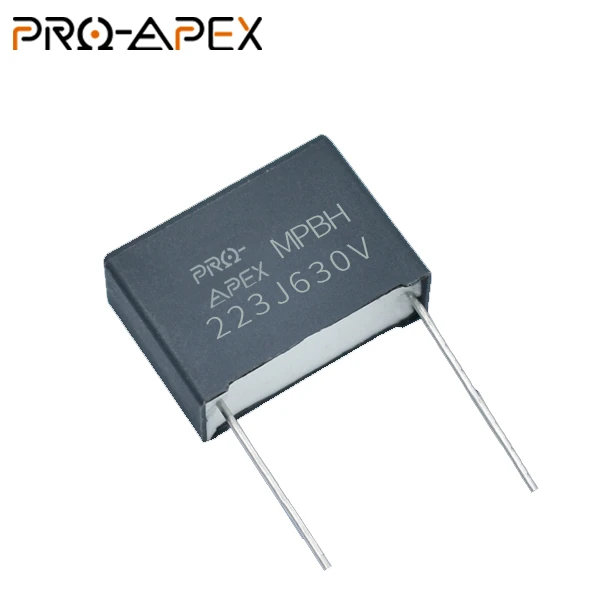
Filtering and decoupling: Film capacitors are often used to filter or decouple signals in electronic circuits, allowing DC signals to pass while blocking or attenuating AC signals. This can help to reduce noise and improve the stability of a circuit.
Timing and pulse shaping: Film capacitors can be used to store charge and discharge it quickly, making them useful for generating pulses or shaping waveforms in timing circuits.
Power factor correction: In AC power systems, film capacitors can be used to correct the power factor by storing and releasing electrical energy as needed.
Motor starting: Film capacitors can be used in motor starting circuits to provide the initial surge of current needed to get the motor up to speed.
Audio and video equipment: Film capacitors are often used in audio and video equipment to filter and decouple signals, improving the overall performance and quality of the equipment.
Telecommunications: Film capacitors are used in telecommunications systems to filter and decouple signals, helping to ensure the reliability and stability of the system.
Construction of Box Film Capacitor
The generic method of development for these capacitors begins with the removal of a thin layer of plastic film. This film's thickness determines the capacitance value. Since the capacitance value increases with a decrease in the gap between the electrodes, the higher capacitance value is thus indicated by the lower film thickness. The standard capacitance value for these capacitors, in general, ranges from 1nF to 30muF.
Once the film is removed according to the desired capacitance value and the breakdown voltage, either aluminum or zinc is metalized and rolled over to form a' mother roll.' The films are only interlaced between sheets of aluminum foil to form the roll in the case of a film/foil capacitor.
This roll is then manipulated to accommodate the capacitor size and the desired electrical characteristics by several processes such as slitting, winding and flattening. The projecting electrodes are subjected to a metalizing process called 'Schoopage' until the capacitor obtains its desired shape and size. To create a protective coating on the electrodes, liquefied metals such as zinc, aluminum, or tin are used here. To burn away any existing defects on the electrode surface, the lateral ends of the winding are then sprayed with compressed air and then exposed to a voltage.
Since the capacitors can be easily influenced by moisture, silicone oil, or some other insulating fluid is impregnated with the winding. Finally, this winding is prepared to be soldered to the capacitor's metallic terminals. The capacitor is subjected to a final round of protection coating until soldered, where its body is dipped into a protected coating or potted on the outer casing.
Cutting the film
Cut the metal foil into the required width according to the product's design capacity using a film cutting machine. The cutting should be without burrs, with a clean appearance and no wrinkles.
Winding
According to the process requirements, select the core and metal foil, and wind them into a core using a winding machine. The requirements for capacitor film capacity should meet the design requirements, the core end should be flat, the film should be clean with appropriate tension, and the film should not be scratched.
Thermal compression
According to the process requirements, select appropriate thermal compression parameters (pressure, temperature, time) on the thermal press to flatten the core. The core should not loosen under slight external force, and the film should not delaminate.
Tape binding
According to the process requirements, select suitable adhesive tape and wind the core into a roll. The adhesive should be sticky with no coverage of the core end.
Spraying gold
Spray metal layers onto the two ends of the core. According to the process requirements, select spraying gold distance, air pressure, wire drawing speed. The thickness and adhesion of the gold layer should meet the requirements.
Rolling the edge
After gold spraying, dismantle the tape binding, and use a rolling machine to remove the residual edges after gold spraying and the excess metal dust adhering to the core surface. The rolling time and speed should refer to the process requirements. The core end should have no excess metal edges, and the surface should have no metal dust.
Vacuum drying
According to the product requirements, choose the appropriate temperature, pressure, and time for the drying chamber to improve the electrical performance of the capacitor film products. The accuracy of the machine's set parameters should be guaranteed.
Charging
According to the characteristics of the capacitor film product, choose the appropriate increasing voltage to improve the electrical performance of the capacitor film product. The voltage should be set accurately.
Welding
Weld the pins on the core. The diameter and length of the wire should be correct, the position should be moderate, the welding current should be correct, the metal foil should not be burned, the solder joint should be smooth without burrs, and there should be no virtual welding.
Inserting
Insert the core into the plastic shell. The core should be located in the middle of the outer shell and fixed.
Encapsulation
Fill the encapsulation material into the plastic shell. The encapsulation material should be correctly proportioned, stirred evenly, and the lead-out end and shell surface should have no resin. The surface should have no bubbles, and the size should be accurate.
By storing electrical energy in the electric field created between the conducting plates and the dielectric film, film capacitors function. Electrons build up on one plate of the capacitor when a voltage is placed across it, generating a negative charge, while the other plate develops a positive charge. Although the dielectric substance blocks direct current from moving between the plates, alternating current can still flow through. Film capacitors are beneficial for smoothing out voltage fluctuations and filtering undesirable signals because of their capacity to store and release electrical energy.
The operating principle of film capacitors is based on electric field effects in dielectrics, usually alumina or polyimide, etc. When a film capacitor is placed between two off-number electrodes, the electric field causes the positive electrode to attract negative ions and the negative electrode to attract positive ions, which will cause charge to be stored in the capacitor. The energy of these charges can also be stored in the capacitor for later use.
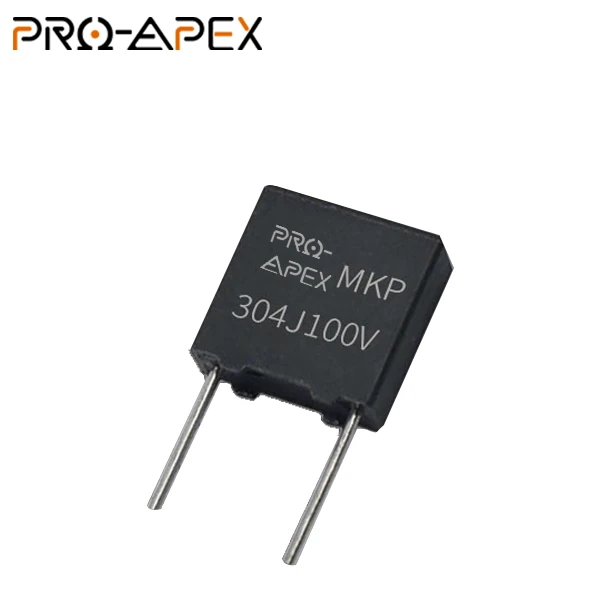
What Is the Lifespan of Box Film Capacitor
The precise type of film used, the operating environment, and the level of manufacture all have an impact on how long a film capacitor lasts. Comparing film capacitors to other types of capacitors, they often have a longer lifespan. Film capacitors may often endure for many thousand hours of continuous usage with good operation and within their authorised limitations. However, the capacitance value may drift over time and their performance may deteriorate as they get older or are exposed to unfavourable circumstances like high temperatures. The dependability and endurance of electronic systems can be increased by performing routine maintenance, monitoring, and replacement of worn-out capacitors.
The Danger of Using Three-noes Box Film Capacitor
The dangers of using uncertified capacitors without brand, label, or certification are significant, especially in households with elderly or children who may not understand electrical devices. A simple mishap can lead to fires causing personal injury and property damage.
As crucial components in electronic devices, capacitors directly affect the circuit's safety and stability. Therefore, it's essential to choose certified products from reputable manufacturers to avoid the risks associated with uncertified capacitors.
Uncertified capacitors often lack insulation and voltage resistance standards, making them prone to electrical faults, leaks, and fires, jeopardizing consumer safety and causing property damage.
Moreover, the unstable performance of uncertified capacitors can lead to poor filtering and overload protection failure, resulting in unstable device operation, noise, distortion, and crashes, affecting user experience.
The poor quality of uncertified capacitors often leads to premature aging and damage, significantly reducing device lifespan. Additionally, the lack of brand, label, and certification makes it challenging for consumers to trace the source of problems and seek compensation, resulting in substantial economic losses.
To ensure circuit safety and stability and protect consumer safety and property, it is crucial to avoid using uncertified capacitors. Choose certified products from reputable manufacturers and adhere to relevant safety standards and regulations when selecting safety capacitors.
FAQ
We're well-known as one of the leading box film capacitor manufacturers in China. If you're going to buy bulk high quality box film capacitor at low price, welcome to get free sample from our factory. Also, customized service is available.
resistor distributor, consumer electronics resistor, thermistor for temperature sensing